Tuesday, December 18, 2012

Efficient home heating, Part 1.

Nighttime lows have been dipping into the twenties, making my cozy little home all the more comfortable.  The Armstrong House, the physical structure that protects me from the raw forces of nature, envelopes me in a bubble of evenly warmed air.  The source of this warmth: underfloor – or radiant – heating. Although winter is a great excuse to wear indoor slippers, they are not much needed as my floors radiate a steady stream of thermal energy.  On those early mornings when my cat's demands for breakfast rip me from the bed, my toes happily waltz naked across the heated floor.
Walking on heated floors is a delight in the Armstrong House


A little background on the Armstrong House 
When the Pound Ridge Land Conservancy (PRLC) committed to renovating the Armstrong House, they decided to use it as a showcase for simple energy efficient building and lifestyle choices.  The PRLC chose to prioritize energy efficiency because it realized that both prongs of conservation (land protection and sustainable lifestyles) need to be practiced and taught.  At the Armstrong Education Center we call this philosophy 'Living Lighter on the Land', and radiant heating is just one of the many ways we demonstrate a low-impact lifestyle.   

How radiant heating warms the Armstrong House
Like the tortoise, radiant heating (AKA, underfloor heating) is slow and steady.  There are many different radiant systems available – air, electric and water – which differ in their heat-carrying medium.  At the Armstrong House we use water (AKA, 'hydronic') to carry heat throughout the house.  Here is how our system works: roughly 90 degree water is continually pumped throughout the house in underfloor plastic 'PEX' tubes.  The water's heat energy leaves the tubes and radiates upward into the cooler room. Radiant heating systems can be thermostatically controlled, just like other home heating systems.  Take a look at the pictures below to understand the basic design of this heating system.

Underfloor tubing runs throughout the entire Armstrong House like in this picture.  

A picture of plastic 'PEX' tubing in a room.  This tubing will be covered by a floor.  

A detailed look at how radiant tubing sits under a floor.  


Radiant heating versus other types of heating
What makes radiant heating so efficient and great feeling is its omnipresence – the tubing underlies nearly all of a room's floor, which means that heat enters the room from almost every inch of ground.  Alternatively, radiators and forced-air systems rely on a few sources of very hot air, which is expected to permeate a space.  The result with these systems are drafts, hot pockets, cool pockets and – as you'll see – a room that is heated from the top down.


Two systems of heating compared.  Forced-air systems on the left and radiant floor systems on the right.  In most cases, radiant heating is more efficient and comfortable.  

Radiant heating literally heats a room from the bottom up, which means that the space occupied by people (the bottom six feet of the room) is the warmest and most comfortable.  Alternatively, by heating a room in a top-down manner (as in a forced air system), energy is wasted heating unused air.  This also creates very dramatic and noticeable differences in heat conditions between floors.  For example, I remember in my grandmother's house the second floor was brutally hot while the first floor was comfortable.  Besides being uncomfortable, this style of heating is inefficient.    


Comparing how heat fills a room in different heating systems.  Radiant heating on the left vs. force-air heating on the right.  

The body's response to different heating systems
It is said that radiant heating has advantages over other heating systems on a purely physiological level.  When looking at the heating preferences of the human body, our feet and legs like to be the warmest and our heads like to be the coolest.  The diagram below reiterates the point that a bottom up heating system has advantages over a top down heating system.


Our bodies like to be heated from the bottom up.  Our heads like to experience slightly cooler temperatures than our legs and feet.  


When trying to reduce your energy and resource use, you have to tackle the large energy hogs, like home heating.  Here in the north, many months are spent heating the home and an efficient system will make a large difference over time.  This post is Part one of a series on efficient home heating.  In part two I will show you how the water in our radiant system is heated.  Here's a hint:  Its big, yellow and likes to sit in the sky.  Stay tuned.      

More reading
There are lots of people talking/blogging about radiant heating technology.  It is found all across the country and applied in all sorts of buildings.  Here are some links.  Happy heating!

Tuesday, December 11, 2012

What to do with all this wood?!

Hurricane Sandy happened over a month ago but the signs of her devastation still linger on: crushed roofs, fallen trees and the never ending buzz of chainsaws.  Of the thousands of trees that Sandy pushed over, many were next to people's homes and have since been cut up and removed.  Today's post highlights the role of dead wood in a forest ecosystem and stresses the ecological value of fallen debris. I will take you on a journey through the 'life' of a fallen dead tree:

Some of the many uses of fallen dead wood.  Dead wood is extremely valuable to the forest ecosystem as it provides food, shelter and a source of energy for future organisms.


A pile of sticks and branches makes great hiding places for animals


Once fallen, the crown of the tree (all the branches, limbs and twigs) rests on the ground.  Here it provides birds and mammals with shelter.  An impenetrable pile of sticks is difficult for us humans to move through but ideal for a warbler or a chipmunk hiding from a cooper's hawk.  The thin branches quickly break down and become incorporated into the soil's top layer where they continue to decompose and feed small critters.     


Bigger limbs fill up with insects, which attract hungry animals.


Larger limbs – like those pictured to the right – take years to break down.  They slowly begin to take on water and fill up with ants, beetles and grubs, which attract the pileated woodpecker and the northern flicker.  At every stage of decomposition, these dead limbs provide a unique habitat to decomposers which, in turn, prepare the wood for the next suitable suit of decomposers.  

Hollow logs attract a lot of animal activity.


Large logs may eventually become hollowed out.
These hollow logs act like little bunkers for forest mammals, used for eating in, hiding in and I like to think – napping in.  Exploring around one of these hollowed logs usually shows many sign of animal use such as scat (animal feces) and remnants of an animal meal.  


A 'snag' or standing dead tree.  


What about a dead tree that doesn't quite fall over? This type of dead wood (called a 'snag') is also very valuable to the forest ecosystem.  Snags will eventually fall to the ground and contribute pieces of wood to the soil but before they do, they act as a sort of wildlife condominium.  Notice the snag to the right.  See all the round holes?  These round holes happen when a rotted limb falls off or when excavated by a woodpecker.


A flying squirrel in a tree cavity.  Picture by me!


Once established, a tree cavity will be used for many years by squirrels, flying squirrels, owls, song birds and raccoons.  To read more about the importance of snags, see my Blog posts from March and April. 


There is a lot you can do with your downed wood to provide wildlife with useful habitat, shelter and food after a storm like Hurricane Sandy.  


1.  Leave logs on the ground to rot.  


2.  If you want to dress up your decomposing logs, you can turn them into rustic outdoor furniture.  


3.  Let broken trees stand and turn to snags.  


4.  Pile up downed branches to provide small animal habitat.   


At the Armstrong Education Center in Pound Ridge, NY I practice these different methods of using downed wood for wildlife.  As an added bonus you can expect to save some cash because these practices are often less expensive than paying a crew to cut, chip and haul your downed trees.  This is just another trick to Living Lighter on the Land.  

Monday, November 12, 2012

When a hurricane visits a forest


One day I was walking with my mentor in the woods when he asked me ‘Why are all these trees the same age?’.  With his hands in his pockets and a silly grin on his face (as was his style), he stood facing a small clump of young sugar maple trees.  These ten trees –all roughly the same size and age— went unnoticed until Jeff drew my attention to them.  Before he asked about them, they simply merged without distinction into the rest of the forest.  Now, they stood out as a single group with an obvious common history.

What was the history of this group of trees?  What took place to result in a tidy patch of even aged trees?  The answer is in today's post...

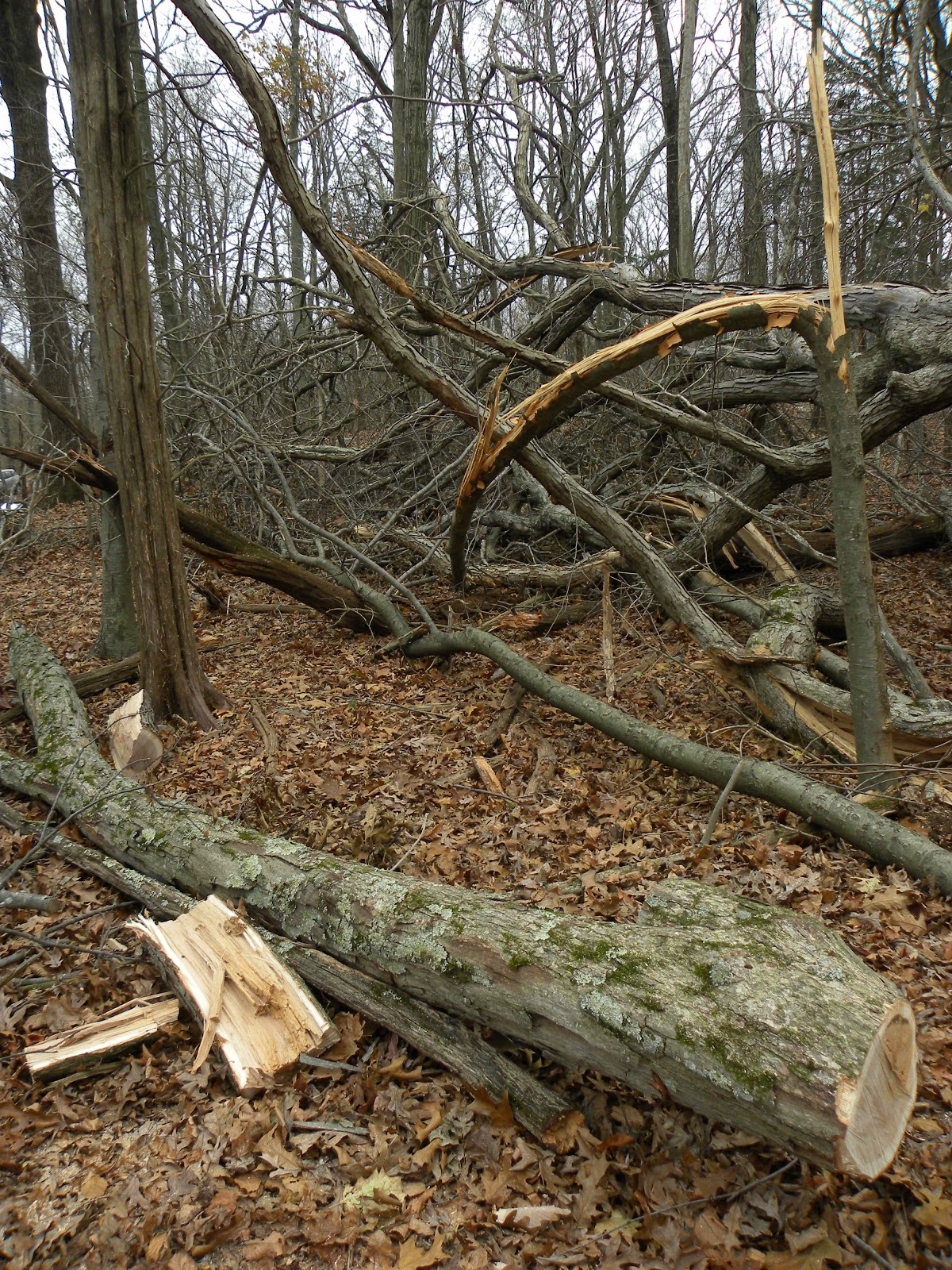
I was reminded of that day on a recent visit to Carolin’s Grove, one of the preserves owned and managed by the Pound Ridge Land Conservancy.  Late October's Hurricane Sand visited Carolin’s Grove like she did any other place in Pound Ridge.  The preserve’s namesake—an 80 year old grove of Norway spruce—was torn to bits by the storm.  Some trees were entirely torn from the ground (roots and all), but more commonly they were left standing, splintered and shattered in half.  As I walked through the wreckage my eyes were drawn up to the sky, which now occupied large gaps in the forest canopy where spruce trees stood only a few days before.


  The following was the sequence of my thinking: 
My thought process as I gaze up through a gap in the forest canopy.  

Every so often, something comes along and kills a handful of perfectly good trees and replaces part of the forest canopy with a wide open gap.  All types of catastrophes can cause a gap in a forest canopy: hurricanes, fire, pathogens (i.e., insect, fungi), ice storms, wind storms, lightning, and let’s not forget the good old fashioned ax.  
A view from Carolin's Grove after Hurricane Sandy.  Forest all over Pound Ridge, NY were devastated by her strong winds.  

What happens once a canopy gap is produced?  Typically, trees grow to fill in the gap.  More specifically, a handful of very lucky trees get an extra dose of light and prosper…upward.  Think back to the story at the beginning of this post – could this have been the cause of the ten evenly sized maple trees?

In one sense, last week’s Hurricane Sandy was a perfectly normal forest phenomenon; forests along the eastern seaboard and in New England have been dealing with bad storms for as long as there have been forests.  Sandy represents one piece in a never ending cycle of tree death, birth and growth.  There is, however, something happening in the forest these days which may alter the cycle.  These days, our forests are experiencing a little extra pressure which affects the processes of birth and growth.  Any guesses?

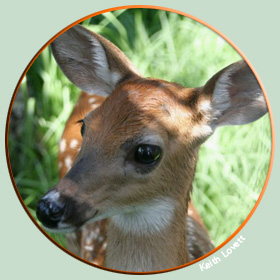
A cute little white tailed deer.  In Pound Ridge, NY white tail deer are so numerous that they prevent any new trees from growing in the forest.  

The current deer density is so high that it suppresses new trees from being recruited into the forest.  For effect, I'll say it in a few different ways: new trees don’t grow in Pound Ridge; trees fall, but new ones don’t grow back; with every storm, our tree count goes down; every day, our forests are getting thinner and thinner; many new gaps go unfilled.  I'll express it in economic terms: we are only withdrawing from our bank account—there hasn’t been a deposit in years.  

Need proof?  Go to the forest behind your house and find a tree less than 5 feet tall.  You'll be lucky to find one.  This is not forests in other places look like. Most forest can replenish their toppled trees, and they do so with a forest floor full of young trees waiting for a gap to open in the canopy.      

I spent last autumn in a part of Maine where logging is the industry.  I spent endless hours exploring the logged forests, learning great lessons in forest regeneration; all places recently cut were home to fresh clumps of young trees, fighting their way to the sun.  I didn’t mind the destruction to the trees because the forest’s future grew roughly knee high and smelled of fresh spruce as I brushed past it.  

Unlike the regrowing forests of Maine, the barren forest floor of Pound Ridge lacks promise for our forest’s future...

Thursday, November 8, 2012

A stranger among your maples

The forests of Pound Ridge, NY are filled with maples and they live in just about every part of the landscape: on wet sites and dry sites, south facing slopes and north-facing slopes, in the shade and in the sun.  We have six maple trees in total:  
Red maple (Acer rubrum).  A very common maple found in wetlands.

Black maple (Acer nigrum).  While it is said to grow in this area, I have not seen it in the wild.

Striped maple (Acer pensylvanicum). This small tree is found in only the coldest places of the area (i.e., exposed, north facing sites at high elevation) 

Silver maple  (Acer saccharinum).  This tree lives on floodplains.


Sugar maple (Acer saccharum). The most common maple around Pound Ridge, NY and the one from which we make maple syrup. 


 Norway Maple: INVASIVE MAPLE. 
This maple tree is not from North America.  Since being brought here it has negatively changed the forest.  

The norway maple is said to be invasive because it spreads quickly through our forest, outcompeting native trees and shading out forest wildflowers.  The tree is also undesirable from a forester's perspective – when compared to the native (and more desirable) sugar maple, the wood of the Norway maple makes poor lumber and burns cooler.

Now, during the second week of November the Norway maple is very easy to spot in the forest.  Now, its yellow and orange leaves stand out against a grey (or after yesterday's snowfall, white!) leafless forest.  In the grand show of fall foliage, the Norway maple is late to the party.  All of the other maples already shed their leaves but the Norway is only just now entering its dormancy.  Below are pictures I took to help train your eyes to this plant.

A Norway maple up close.  Notice that it is the only tree still holding colorful leaves

Large Norway maple trees along side a road.  One in the foreground and one in the background.  


The entire yellow band in the center of the photo is comprised of Norway maple trees.  

Try to spot these yellow trees as you go through your day – you'll be amazed just how many are invading the forest.  I spent a few hours this week girdling Norway maple trees at the Armstrong Education Center in Pound Ridge, NY.  

Wednesday, November 7, 2012

Hurricane Sandy

My heart goes out to all the people who have lost something to Hurricane Sandy.  In these hard times I hope you find support and that your life regains a sense of normalcy soon. 


A little bit of love for the victims of Hurricane Sandy